

Review · USA
Entire Freedom Trail Walking Tour: Includes Bunker Hill and USS Constitution
Boston’s Freedom Trail is more than a line of red bricks. It is a four-hour story about power, protest, money, faith, and war, told as you walk from Beacon Hill through downtown Boston and across to Charlestown. This tour covers the entire 2.8-mile route, including Bunker Hill and the USS Constitution, so you do not have to piece the trail together on your own.
I like the way guide Mark connects cause and effect instead of treating each site as a separate stop. I also like the small group limit of 16, the easy-to-follow maps, and the extra details about women, abolitionists, and lesser-known revolutionaries. The main drawback is simple: four hours on foot is a real commitment, and interior admission fees are not included.
Key things to know before you book
- The full route takes about four hours: You begin at the Massachusetts State House and finish at the USS Constitution in Charlestown.
- Mark provides the historical thread: His approach links the Boston Massacre, Tea Party, Lexington and Concord, French support, and Bunker Hill.
- The group is capped at 16 people: That gives you a better chance to hear the guide and ask questions.
- The walk is manageable but long: Much of it is on fairly level ground, but expect roughly 2.75 miles and many hours standing.
- Several interiors cost extra: You see the buildings and hear their stories, but admission tickets are not included.
- The ending is not back at the starting point: Plan to continue from the Charlestown Navy Yard after visiting Old Ironsides.
Why this four-hour Boston walk works
The best reason to choose this tour is its complete route. Many Boston walks focus on the downtown section and leave out Charlestown, where the Bunker Hill Monument and USS Constitution bring the story toward war at sea and on land. Here, you follow the trail from the Massachusetts State House all the way to the Navy Yard.
That full route matters because the American Revolution did not happen at one dramatic spot. It grew from years of arguments over law, taxation, church power, trade, military occupation, and political rights. Mark’s job is to show how those pieces connect.
The tour begins at 10:00 a.m. on Beacon Street near Park Street. The morning start gives you a practical way to use your first full day in Boston. You will get a solid introduction to the central sights, then finish near the USS Constitution Museum, where you can continue exploring Charlestown.
Mark is the named guide associated with this experience. His style is conversational and grounded. He uses maps and original material to explain the action, rather than relying only on familiar legends. You can expect humor, questions, and plenty of context, but not a theatrical performance.
The small group limit is another plus. A maximum of 16 people is large enough to keep the tour social, but small enough for the guide to manage street crossings, answer questions, and keep everyone together. One useful detail from the feedback is that Mark has sometimes provided extra water and made sure the pace worked for the group.
More hikes and treks around the USA:
- Lower Antelope Canyon Hiking Tour
★ 5.0 · 6,216 reviews - Boston Freedom Trail Walking Tour with Costumed Guide
★ 4.5 · 2,531 reviews - Multnomah Falls and Columbia River Gorge Half-Day Hiking Tour
★ 5.0 · 2,108 reviews
From the State House to Granary Burying Ground
The opening stop is the Massachusetts State House, designed by Charles Bulfinch. You also hear about the earlier buildings used as seats of Massachusetts government, which gives you a quick view of how the colony and state developed politically.
The State House is a good place to begin because the tour starts with government, not battle. You are introduced to the institutions that later came into conflict with British authority. The visit lasts about 10 minutes, and interior entry is not included.
Next comes Park Street Church. When it was built, it was the tallest building in the country. Its story reaches beyond the Revolution, touching the abolition movement and the fiery sermons that earned the area the nickname Brimstone Corner.
The short stop here is useful because it reminds you that Boston’s political life was shaped by religion and reform long after independence. This is one of the tour’s strengths: you are not rushed from one famous patriot to the next. You get some of the city’s wider social story too.
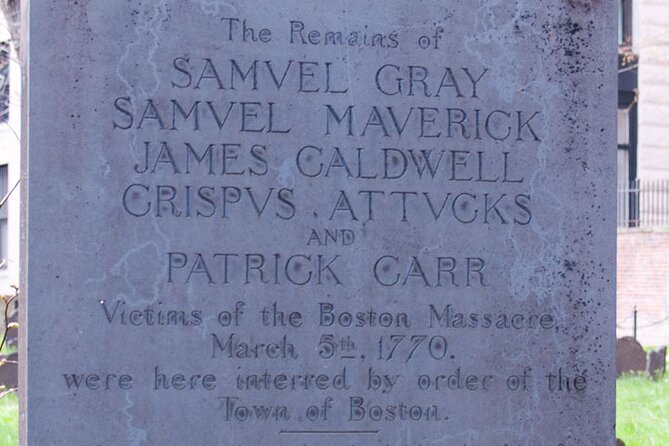
At Granary Burying Ground, you meet several major figures of the Revolution. Samuel Adams, Paul Revere, and John Hancock are buried here, along with victims of the Boston Massacre. The cemetery is free to enter, and the guide provides brief introductions to the people resting inside.
I find this kind of stop more valuable than simply photographing a famous grave. The guide explains what each person did and how their role fits the larger story. It helps turn names from a schoolbook into people with competing goals and real consequences.
Churches, courts, and the road to rebellion
King’s Chapel brings you back to the religious tensions of colonial Boston. The 1749 Anglican church was placed on land that had been taken by the Crown in the 1680s, creating an early conflict between Puritan Boston and royal authority.
You will not tour the interior as part of the price, but the outside setting and the explanation are enough to show how religion and government overlapped. In colonial Boston, a church could also be a political statement.
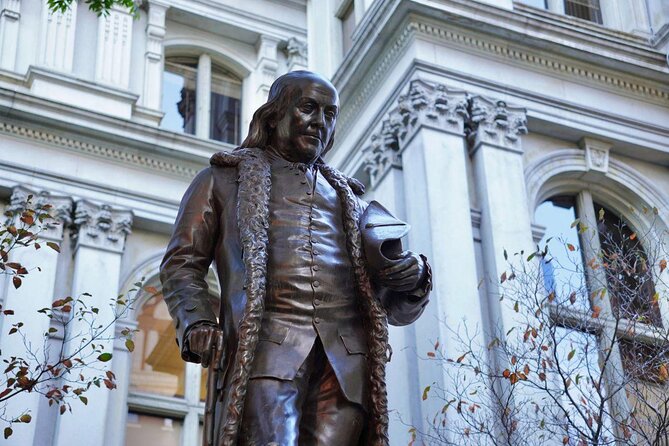
Old City Hall offers a change of pace. Here, the guide points out a Benjamin Franklin statue and a marker tied to the oldest still-operating school in the colony. The stop is free and takes about 10 minutes.
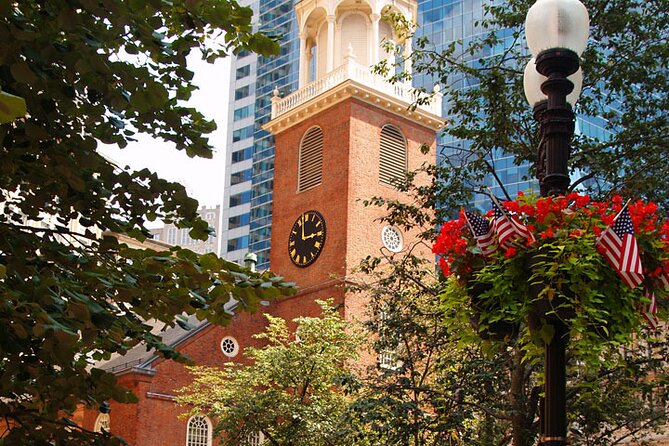
The Old South Meeting House is one of the most important stops on the route. Colonial meeting houses were places where people heard sermons, arguments, and political speeches. Samuel Adams used this Puritan meeting house as the setting for the meeting that led directly to the Boston Tea Party.
The value here is not just the famous event. You see how public meetings worked before modern political parties, mass media, or social media. The building served as a place where ideas could spread quickly through a crowded city.
Admission to the Old South Meeting House is not included. If you plan to return inside, make note of the extra cost and allow time after the walking tour.
At the Old State House, the story becomes more confrontational. This was once the center of British government in Massachusetts. The building also hosted a 1761 court battle that exposed the colonists’ anger over British power.
The same area became the site of the 1770 Boston Massacre. The popular version is familiar, but the tour does not treat the event as a simple good-versus-evil tale. Mark examines what happened, how the crowd and soldiers interacted, and how the incident was used in political arguments.
That careful treatment is one of the stronger parts of the experience. You still get the memorable story, but you also see how images, language, and public outrage helped shape political action.
Faneuil Hall and the people behind the slogans

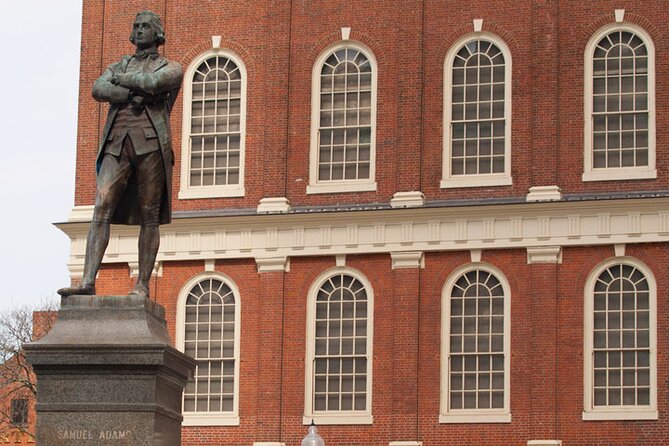
Faneuil Hall is another stop where public speech takes center stage. Samuel Adams spoke here about taxation and representation. Frederick Douglass later spoke here as an escaped slave and abolitionist.
That pairing is important. The story of American liberty did not end with independence, and the language used by revolutionary leaders was later used to challenge slavery and unequal rights. The tour gives you a chance to see Boston’s political tradition across different periods rather than stopping in 1776.
Faneuil Hall Marketplace is free to visit, though shops and food are separate. The tour itself does not include a meal break, so you should eat before the 10:00 a.m. start or plan lunch after finishing in Charlestown.
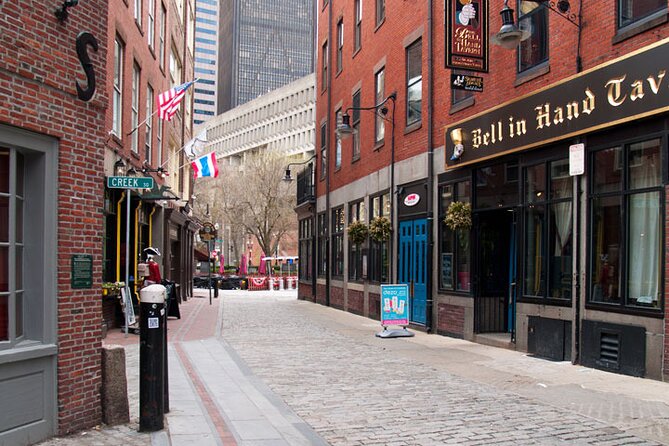
The Blackstone Block adds some of the route’s more unusual details. You hear about the Massachusetts Spy newspaper, a bar known as the Headquarters of the Revolution, and the Ebenezer Hancock House.
Ebenezer was John Hancock’s brother, and his home was used to store money sent by France to support the Revolution. This is the type of detail that gives the tour texture. You are not only visiting the homes of famous men. You are seeing how money, communication, and local networks helped keep a rebellion alive.
Same mountains, a different route up:
- Small Group: Valley of Fire Half Day Tour from Las Vegas
★ 5.0 · 2,130 reviews - San Francisco: Yosemite National Park & Giant Sequoias Hike
★ 4.5 · 1,777 reviews - Valley of Fire Guided Hike from Las Vegas
★ 5.0 · 1,611 reviews - Los Angeles: The Original 2.5-Hour Hollywood Sign Hike
★ 5.0 · 1,468 reviews
Paul Revere, Old North, and the move toward war
The Paul Revere House is one of the oldest surviving homes in Boston. Revere bought the 1680 house in 1770, and the stop gives you a more personal view of a man often reduced to one midnight ride.
You learn that Revere fathered 16 children with two wives, a fact that makes the house feel less like a monument and more like a family home. Interior admission is not included, and the stop is brief, about five minutes.
Old North Church is the next major link in the story. From its steeple, lantern signals warned patriots in Charlestown about the British movement toward Lexington and Concord. The church helps explain how information traveled through the city and across the water before telephones, radio, or fast transport.
This is a good place to pay attention to geography. The route is not just a list of buildings. Streets, waterways, hills, and sightlines shaped what people knew and how quickly they could respond.
At Copp’s Hill Burying Ground, you get a short visit and a clearer sense of the ground around the coming battle. The cemetery helps explain the geography of the Battle of Bunker Hill, which was actually fought on Breed’s Hill.
That correction is not a minor footnote. It shows how historical names can become fixed even when they do not perfectly match the place where events occurred. The guide also points out a grave marker with its own story, adding another human detail before the tour crosses into Charlestown.
Bunker Hill and the final stop at Old Ironsides
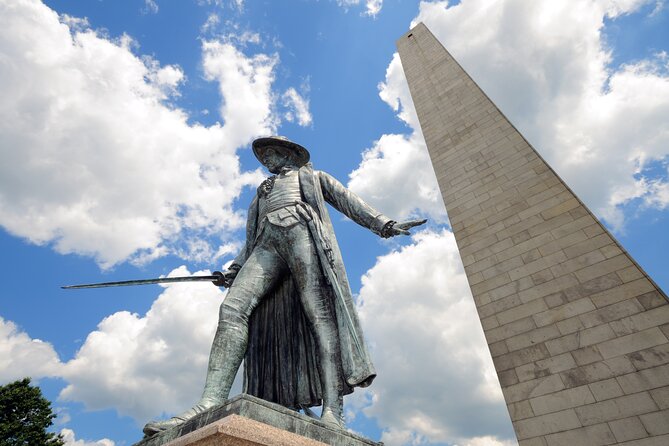
The Bunker Hill Monument is where the revolutionary story turns into open war. The battle was fought on Breed’s Hill, and the British won the field, but at a terrible cost. British losses were about three times those of the Patriots.
That result helps explain why the battle mattered. A Patriot defeat could still prove that colonial forces could inflict serious damage on the British army. The stop is free, and the monument gives the tour a strong visual endpoint for the land campaign.
The final stop is the USS Constitution, known as Old Ironsides. It is the oldest commissioned warship in the world and served the United States in American and foreign waters.
Ending here broadens the tour beyond the land events of Boston. You finish with the young nation’s naval history and a physical object that survived from the early United States. Admission to the ship itself is free according to the tour details, though the nearby museum is a separate place to explore.
The tour ends at Building 22 in the Charlestown Navy Yard, not back at Park Street. That is useful to know when planning the rest of your day. You will need to arrange your own way onward, but the location puts you near the USS Constitution Museum and the Charlestown waterfront.
What the $79 price includes
At $79 per person, this is not the cheapest way to see the Freedom Trail. It can still be a good value if you want the complete route and a guide who provides a connected explanation rather than isolated facts.
The price includes roughly four hours of guided walking, the full Freedom Trail route, Bunker Hill, and the USS Constitution. Guide gratuity is also included, and Mark does not expect or accept tips. That makes the final price easier to understand because you do not need to add a customary tip afterward.
The main extra cost is interior admission. The State House, Park Street Church, King’s Chapel, Old South Meeting House, Paul Revere House, and Old North Church are listed as stops, but admission tickets are not included. You still see the buildings and receive the explanation from outside, which is enough for many people. If interiors are a priority, budget for them separately.
Compared with walking the trail alone, the real value is the interpretation. The route is free to follow, but the cause-and-effect links, maps, historical corrections, and lesser-known figures are what you are paying for.
Who should take this tour?
I would choose this tour if you enjoy history, walking, and a guide who goes beyond the standard names. It works especially well for families with teenagers, couples, solo visitors, and adults who want a serious introduction to Boston’s revolutionary past.
Children under 12 may find four hours too long unless they already enjoy history. The feedback makes that point clearly. Teenagers are more likely to appreciate the humor, debates, military strategy, and human stories.
You should be comfortable walking for several hours. The route is often described as slow-paced and mostly flat, and it can work for seniors who are used to extended walks. Still, comfortable shoes are essential, and you should be ready for roughly 10,000 steps depending on your route and movement around each stop.
The tour is offered in English, with mobile tickets. Service animals are allowed, and the route is near public transportation. It requires reasonably good weather. If poor weather cancels the experience, you are offered another date or a full refund.
Free cancellation is available up to 24 hours before the 10:00 a.m. start time. Changes or cancellations inside that window are not refunded.
Should you book the entire Freedom Trail walk?
Book it if you want one substantial morning that covers Boston’s major revolutionary sites in a clear order. Mark’s strength is connecting places and people, including women, abolitionists, journalists, financiers, and less famous figures who usually disappear from a basic Freedom Trail walk.
Skip it if you prefer to explore at your own speed, spend a long time inside each museum, or divide the trail across several short visits. Four hours is a lot of walking, and the tour does not include interior admission.
For most history-minded visitors, the complete route makes the $79 reasonable. You see the central trail, Bunker Hill, and the USS Constitution without having to solve the route yourself. Bring water, wear good shoes, eat beforehand, and leave room in your schedule after the tour for the Charlestown Navy Yard.
FAQ
How long does the Entire Freedom Trail Walking Tour last?
The tour lasts approximately four hours and covers the full 2.8-mile, or roughly 4-kilometer, Freedom Trail route.
Where does the tour begin?
The meeting point is on Beacon Street near Park Street in Boston, Massachusetts.
Where does the tour finish?
The tour ends at the USS Constitution in the Charlestown Navy Yard, at Building 22 near the USS Constitution Museum.
What time does the tour start?
The scheduled start time is 10:00 a.m.
Is admission to the historic interiors included?
No. Admission to interiors is not included. The tour visits the exterior sites and explains their history, while any interior tickets must be purchased separately.
Is the USS Constitution included?
The tour ends at the USS Constitution, also called Old Ironsides. The tour information lists admission as free.
How large is the tour group?
The maximum group size is 16 people.
Is the tour suitable for children?
The tour can suit families with teenagers. Children under 12 may find the four-hour length demanding unless they already have a strong interest in history.
Can I cancel for a refund?
You can cancel at least 24 hours before the scheduled start for a full refund. Cancellations or changes made less than 24 hours before the start are not refunded. If poor weather causes the operator to cancel, you are offered a different date or a full refund.
Recently reviewed hikes in the USA
- Asheville: Yoga on a Mountain Hike★ 4.7 · 7 reviews
- Antelope Valley: Ligai Si Anii Canyon Hiking Tour★ 4.9 · 13 reviews
- Anchorage: Matanuska Glacier Hike with Transfers★ 4.7 · 20 reviews
- Acadia Full Day Small Group Tour & Hike★ 5.0 · 9 reviews
- Yosemite Valley Private Hiking Tour★ 5.0 · 83 reviews
- The Narrows: Zion National Park Private Guided Hike★ 5.0 · 209 reviews
- Private Family Hike in Yosemite★ 5.0 · 37 reviews
- Private Guided Hiking Tour in Yosemite★ 5.0 · 94 reviews
USA Hiking Tours, compared.


Small Group: Valley of Fire Half Day Tour from Las Vegas
Read our review →
Multnomah Falls and Columbia River Gorge Half-Day Hiking Tour
Read our review →
San Francisco: Yosemite National Park & Giant Sequoias Hike
Read our review →

Los Angeles: The Original 2.5-Hour Hollywood Sign Hike
Read our review →
Small Group Waterfall and Rainforest Hiking Adventure on Maui
Read our review →
Other lists this hike appears in