
Review · INDONESIA
Sidemen Trekking: A Walk from a Different Perspective
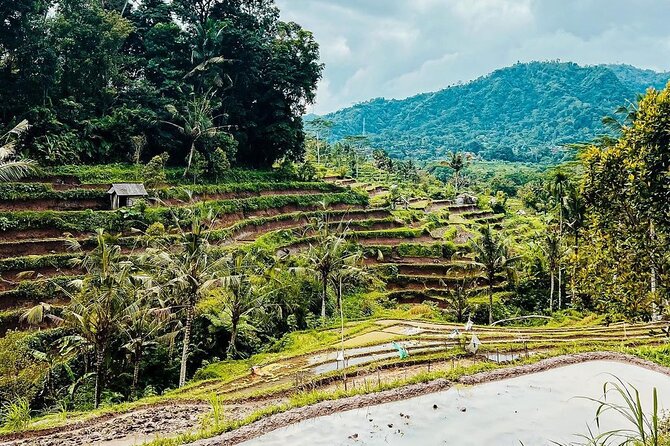
Sidemen’s best scenery is not viewed from a lookout. You walk through it, along narrow rice-field paths, past farmers at work, across an old wooden bridge, and into villages where daily life carries on around you. This two-hour walk gives you a close look at Bali’s farming country without the crowds often found around Ubud.
I like two things especially: the route is one-way, so you keep seeing new scenery, and the local guides add meaning to what you pass. Guides such as Adi, Daria, Wayan, Komang, and Adidas explain crops, irrigation, temples, and village life in clear English. The main drawback is the footing. Expect slopes, narrow field walls, slippery patches, and a bridge that can feel a little shaky.
Sidemen Trekking at a Glance
- Walk through working rice fields: See plowing, planting, cultivation, and harvesting rather than just posing beside a terrace.
- Follow the Subak irrigation system: Learn how water reaches the fields through the traditional Subak of Ogang.
- Cross the Yellow Bridge: Jembatan Kuning Tukad Yeh Unda is a memorable stop, though it is not a place to rush across.
- Meet the walk in Sidemen Market: Morning departures can include time at Pasar Sidemen, open from 5:00 AM to 10:00 AM.
- Finish at a village warung: The route ends at Warung Ume Anyar in Ogang Village, not back at the starting point.
- Pay little for a local perspective: At $13 per person, the guide, water, and access to paths you might not find alone make this strong value.
Why Sidemen Looks Better on Foot
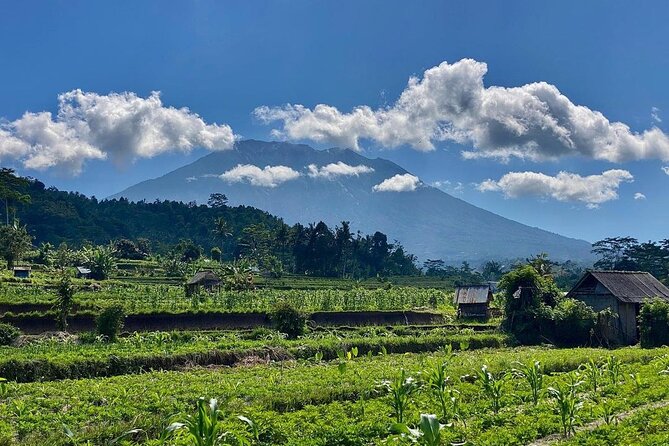
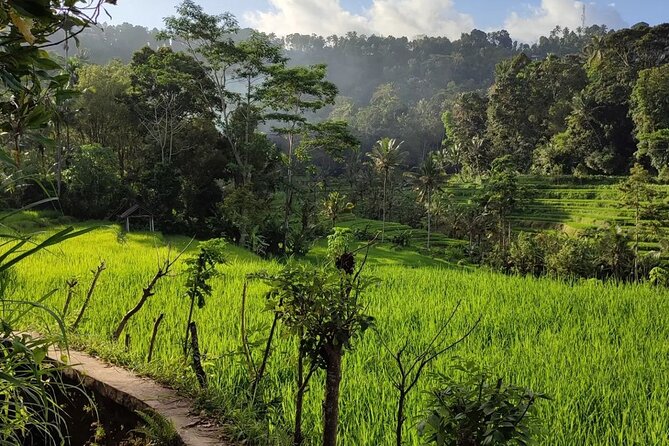
Sidemen is known for rice terraces and views toward Mount Agung, but a roadside stop only gives you part of the picture. The charm here comes from movement: a field path becomes a village lane, a water channel turns into a bridge crossing, and a quiet terrace opens into a broad view over the valley.
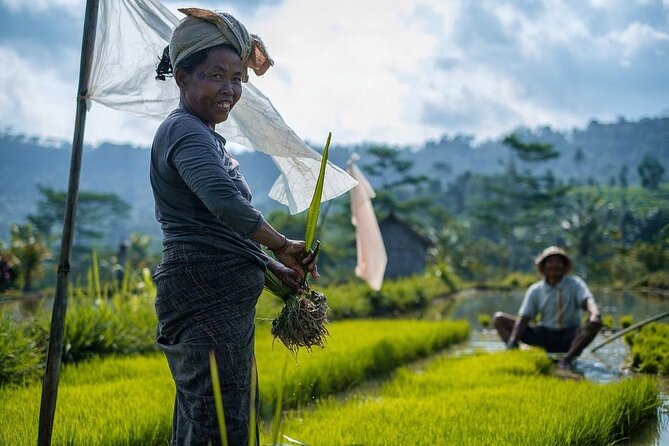
I like that this is not built around one grand viewpoint. The experience is a steady look at how Sidemen works. You see farmers handling crops, people moving through the village, shrines and temples used by local residents, and a mix of plantations growing beside the rice.
The route also gives you a more useful understanding of the fields. Your guide can point out irrigation channels and explain the Subak system, the traditional Balinese way of managing water among farming communities. That makes the rice terraces more than a pretty backdrop. You begin to understand the work and cooperation behind them.
The walk is gentle in pace, but it is not a flat stroll. You go up and down village streets, climb toward the fields, and walk along narrow paths between paddies. In wet weather, the earth can be slick. Good footwear matters more here than speed.
More hikes and treks around Indonesia:
- Bali: Sunrise Mount Batur Guided Hike with Breakfast
★ 4.8 · 9,660 reviews - Bali: Mount Batur Sunrise Guided Hike and Natural Hot Spring
★ 4.8 · 9,284 reviews - Bali: Mount Batur Sunrise Trek With Guide and Breakfast
★ 4.8 · 3,461 reviews
Starting at Pasar Sidemen and Upa Boga
The meeting point is at Pasar Sidemen, the traditional market on the main road. Look for the shop marked Upa Boga. Your guide meets you there, and this is the point where you should make sure you have water, sun protection, and secure shoes before setting off.
If you choose a morning start, the market can add a useful opening scene. Pasar Sidemen is open from 5:00 AM to 10:00 AM, and the market visit itself lasts about 10 minutes. You might see the local food trade getting underway, but this is a short stop rather than a full market tour.
A later start means you may miss the market. That is not a problem if your main goal is the countryside, but book an early session if you want both parts. The start time depends on availability, so check before booking.
From the market, the walk shifts quickly from the main street toward quieter village paths. This change is part of the pleasure. You do not spend two hours beside traffic or on a broad tourist path.
Rice Terraces, Plantations, and the First Views

The main portion of the walk leads upward toward the rice fields, with Mount Agung as the direction to watch. On clear days, the mountain and the Sidemen valley create the kind of view that makes you stop naturally rather than because the schedule says it is time for a photo.
The first scenic section lasts about 35 minutes. It includes a photo stop, village walking, and views along the way. Your guide may pause to point out crops and plants, and several guides also help take photos. This is useful if you are traveling as a couple or small group and want more than quick snapshots of one another.
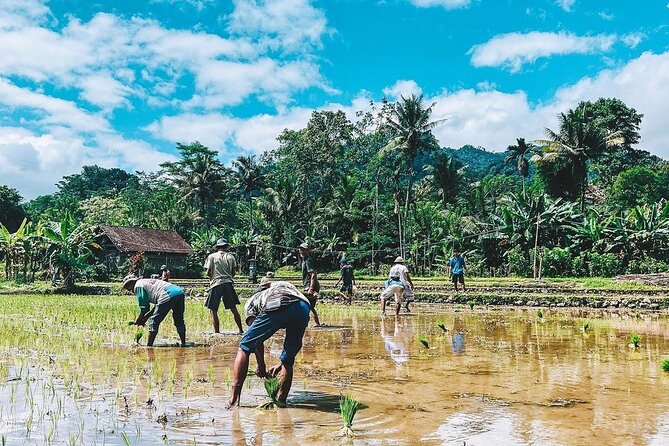
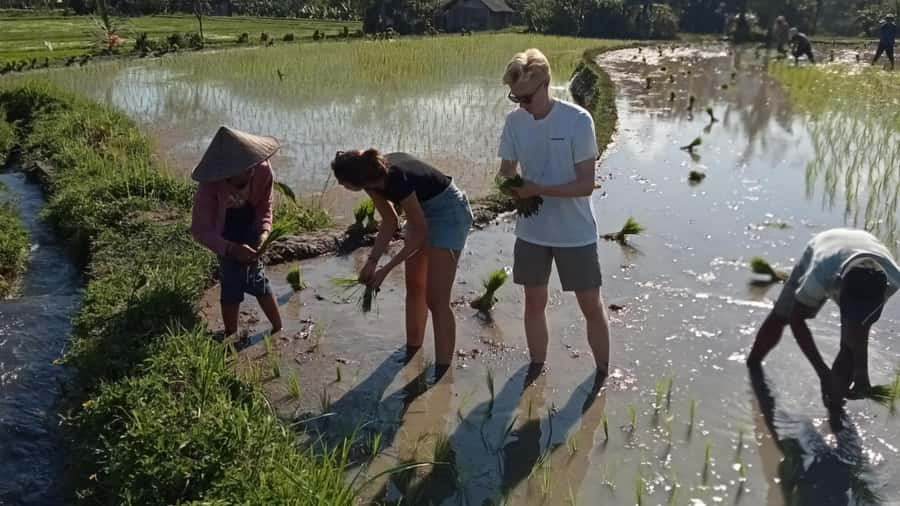
Sidemen’s fields feel different from the more heavily visited rice areas around Ubud. The paths are less polished, and you may see farmers actively plowing, planting, tending, or harvesting. That also means the walk is less controlled. A narrow ridge between fields may be your actual path, and the surface can be wet or uneven.
I would wear shoes with a firm, non-slip sole. Sports shoes are listed as suitable, and hiking shoes are even better. Sandals and flip-flops are not allowed, for good reason. Long trousers can help when the route passes through high grass, where insects and red ants may be present.
Crossing Jembatan Kuning Tukad Yeh Unda
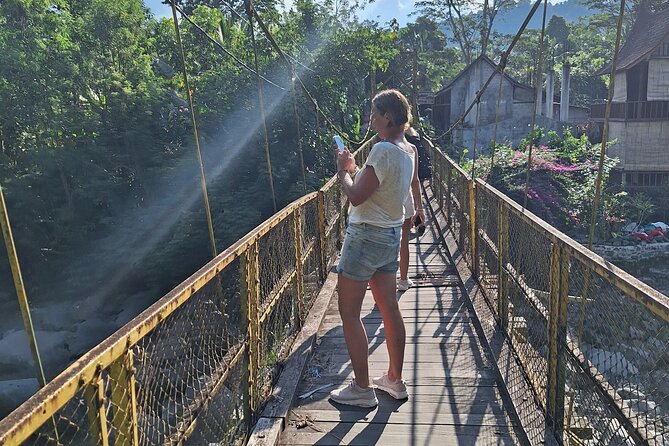
The Yellow Bridge, or Jembatan Kuning Tukad Yeh Unda, is one of the walk’s most distinctive stops. It is a wooden bridge used by people and motorbikes, so it is part of ordinary local transport rather than a structure set aside for sightseeing.
You get about 10 minutes here for a visit and photos. The bridge adds a little drama to an otherwise calm walk. Its narrow construction and slight movement may make you pause, especially if you are not comfortable with heights or uneven crossings.
Follow your guide and take your time. This is not a spot for rushing or blocking the way. The bridge is memorable precisely because it feels like part of the village, not a staged attraction.
Same mountains, a different route up:
- Mount Batur Sunrise Hike and Natural Hot Spring Option
★ 5.0 · 1,927 reviews - From Ubud: Mount Batur Hiking With Hotspring
★ 4.8 · 1,850 reviews - Mount Batur Sunrise Hike with Breakfast
★ 5.0 · 1,757 reviews - Mount Batur Sunrise Trekking
★ 5.0 · 947 reviews
Dukuh Village and the Human Side of the Walk
After the bridge, the route continues through Dukuh village. This section takes about 25 minutes and brings you closer to local homes, roads, temples, and everyday movement.
A temple used for prayer by local villagers appears along the route. Your guide can help you understand what you are seeing and remind you to behave respectfully. Dress should be practical and modest enough for passing through a village and near religious places.
This is also where the walk can feel most different from a standard photo excursion. You are not simply looking at Bali from the edge of the road. You are passing through a community, and the guide helps explain the relationship between homes, farms, water, and worship.
Guides come from the area, and that local connection matters. Adidas is from the village and has explained local plants, rice farming, and village life with plenty of humor. Daria and Adi have also been praised for patient explanations and careful pacing, while Wayan, Komang, and Gede have guided groups through the fields with strong English. The guide assigned to you can vary, but the local approach is central to the experience.
Babakan Dukuh Rice Terrace and Subak Ogang
The longest section is the walk through Babakan Dukuh Rice Terrace, with about 45 minutes for sightseeing, photos, and walking. This is the heart of the tour.
You follow irrigation routes carrying water from higher ground and pass through the Subak of Ogang. Subak is not simply a channel beside a field. It is a traditional system for organizing water and farming among local communities. Seeing it on foot helps you connect the engineering of the terraces with the people who maintain and use them.
Your guide can explain the farming cycle as you pass fields at different stages. Depending on the season, you might see plowing, planting seedlings, cultivating growing rice, or preparing for harvest. The view changes from one plot to the next, which is another reason the one-way design works well.
The area also includes a mixture of plantations. Rice is the main focus, but the route passes other crops and native plants too. Guides have pointed out local plant life and explained how agriculture shapes the area. If you enjoy learning where food comes from, this is one of the strongest parts of the walk.
The paths can be narrow. At times, you may need to place one foot carefully in front of the other along the raised edge of a paddy. A basic level of balance and fitness is needed, and the route is not suitable for people with low fitness, heart problems, or those over 60 according to the activity guidance. It is also not suitable for children under five or pregnant women.
A family with a six-year-old completed the walk with careful help from the guide, but that should not be taken as a guarantee for every child. If you are bringing children, consider their balance, comfort with slippery ground, and ability to walk for two hours.
Ending at Warung Ume Anyar in Ogang Village

The walk finishes at Warung Ume Anyar in Ogang Village. This is important planning information: you do not return to Pasar Sidemen.
Arrange transport before you start. If you have a private driver, ask for pickup at the finish about two to two and a half hours after the walk begins. If you are staying in Sidemen, arrange transport through your hotel. Grab is not recommended because some hotels in Sidemen do not allow Grab drivers to collect passengers, even though drop-off may be possible.
You can walk back to the starting area if needed. The return is about 3 kilometers, or roughly 30 to 40 minutes along the main road. Still, a prearranged pickup is easier after a walk on uneven paths, especially in hot or wet weather.
Hotel pickup and drop-off are not included. Bottled water and the English-speaking guide are included, so bring extra water if you need more than one bottle.
Is $13 Good Value for Two Hours?
At $13 per person, this is inexpensive for a guided walk that includes a local guide, bottled water, village access, field paths, bridge crossing, and explanations of farming and irrigation. The value is not in a long list of paid attractions. It comes from having someone show you where to walk and explain what you would otherwise pass without understanding.
Several parts of the route would be difficult to repeat independently. Rice paddies are not laid out like a public trail, and a map will not tell you which narrow walls are safe to use or how to move through village land respectfully. A local guide also helps you stop at the right places without turning the walk into a race.
The small-group limit of 10 people keeps the experience more personal than a large bus excursion. It also makes it easier to ask questions or pause for photos. For $13, I consider that a very fair trade, especially if you care more about local life and scenery than a polished attraction.
The price does not cover your transport to the start or from the finish. That is the main extra cost to plan for.
What to Wear and When to Go
Bring sunglasses, a hat, sunscreen, and sturdy walking shoes. Hiking shoes or sports shoes with good grip are the sensible choice. Do not wear flip-flops or loose sandals.
A raincoat is wise. The walk can remain enjoyable in rain, but wet weather makes the small paths more slippery. Long trousers may be more comfortable through high grass and can reduce contact with insects.
Morning is the best choice if you want to see Pasar Sidemen before the walk. Later sessions may suit you if the market is not a priority, but you will not have the same market stop.
The activity lasts two hours, though you should allow extra time for meeting your guide and arranging transport at the finish. A driver should be ready around two to two and a half hours after your scheduled start.
Who Will Enjoy This Sidemen Walk?
I would choose this for you if you want to see Bali’s countryside as a working place, not just a set of viewpoints. It suits people who enjoy walking, asking questions, taking photos, and learning about farming and local customs.
It is also a good fit if you have already seen the rice terraces around Ubud and want something quieter and less built around staged photo stops. The route offers broad views toward Mount Agung, but the main reward is being inside the fields and villages.
I would think twice if you dislike uneven ground, narrow paths, wet surfaces, or outdoor heat. This is not a paved promenade. You need steady footing and enough fitness for repeated uphill and downhill sections.
Should You Book Sidemen Trekking?
Book it if you want a low-cost, local introduction to Sidemen and are happy to trade polished paths for real field tracks. The strongest reasons are the one-way route, the chance to see farmers at work, the Subak irrigation system, and the guide’s local knowledge.
Skip it if you need a flat walk, hotel transport, or a guaranteed dry route. For everyone else, this is one of the more useful short activities in Sidemen. Wear proper shoes, arrange your ride from Ogang Village, and choose a morning start if the traditional market matters to you.
FAQ
How long does the Sidemen trekking tour last?
The walk lasts about two hours. Allow extra time for meeting your guide and arranging transport from the finish.
What is the price?
The price is $13 per person.
Where does the trek start?
It starts at Pasar Sidemen, the traditional market on the main road. Look for the shop with the sign Upa Boga, where your guide will meet you.
Where does the trek finish?
The route ends at Warung Ume Anyar Restaurant in Ogang Village.
Is hotel pickup included?
No. Hotel pickup and drop-off are not included. You need to arrange transport to the start and from the finish.
Can I visit the traditional market?
Yes, but the market visit works best with a morning session. Pasar Sidemen is open from 5:00 AM to 10:00 AM, and the planned market visit lasts about 10 minutes.
What does the price include?
The price includes an English-speaking guide and bottled water.
What should I wear?
Wear hiking shoes or sports shoes with good grip. Bring sunglasses, a hat, sunscreen, and consider wearing long trousers. Sandals and flip-flops are not allowed.
Is the route difficult?
The route includes uphill and downhill sections, narrow rice-field paths, and sometimes slippery ground. A reasonable level of fitness and balance is needed.
Is the trek suitable for children?
The activity is not suitable for children under five. Older children may manage it, but the narrow and slippery paths require care.
Recently reviewed hikes in Indonesia
- From Senaru: Mount Rinjani 2-Day Trek to Summit★ 4.8 · 24 reviews
- 2 Days 1 Night Orangutan Trek Bukit Lawang★ 5.0 · 23 reviews
- Mount Batur Sunrise Trekking★ 5.0 · 947 reviews
- Mount Batur Sunrise Trekking – All Inclusive★ 5.0 · 153 reviews
- Private Mount Batur Sunrise Trekking★ 5.0 · 132 reviews
- Yogyakarta: Selogriyo Temple Tour & Java Rice Terrace Trek★ 5.0 · 175 reviews
- Selogriyo Temple and Trekking Java Rice Terraces, hidden waterfall -Nature Java★ 5.0 · 179 reviews
- Rinjani trekking 2D 1N RIM★ 5.0 · 94 reviews
Indonesia Hiking Tours, compared.
Bali: Sunrise Mount Batur Guided Hike with Breakfast
Read our review →
Bali: Mount Batur Sunrise Guided Hike and Natural Hot Spring
Read our review →
Bali: Mount Batur Sunrise Trek With Guide and Breakfast
Read our review →
Mount Batur Sunrise Hike and Natural Hot Spring Option
Read our review →

Mount Batur Sunrise Trekking Private All Inclusive
Read our review →Other lists this hike appears in