Review · AUSTRALIA
Uluru: Guided Trek of Uluru’s Base in a Small Group
Uluru changes character as the first sunlight reaches its red walls. This six-hour walk lets you see the monolith from every side, rather than stopping at one lookout and calling it done. The full base walk includes ancient rock art, Mutitjulu Waterhole, Kantju Gorge, and stories tied to the Anangu people.
I especially like the small group of up to 11, which gives your guide room to answer questions and keep the pace comfortable. I also like the early start: you walk before the outback heat becomes the main attraction. The trade-off is clear, though. This is about 10.5 kilometres on foot, and the early pickup can be around 5 a.m., so it demands a reasonable level of fitness and a willing alarm clock.
Key points at a glance
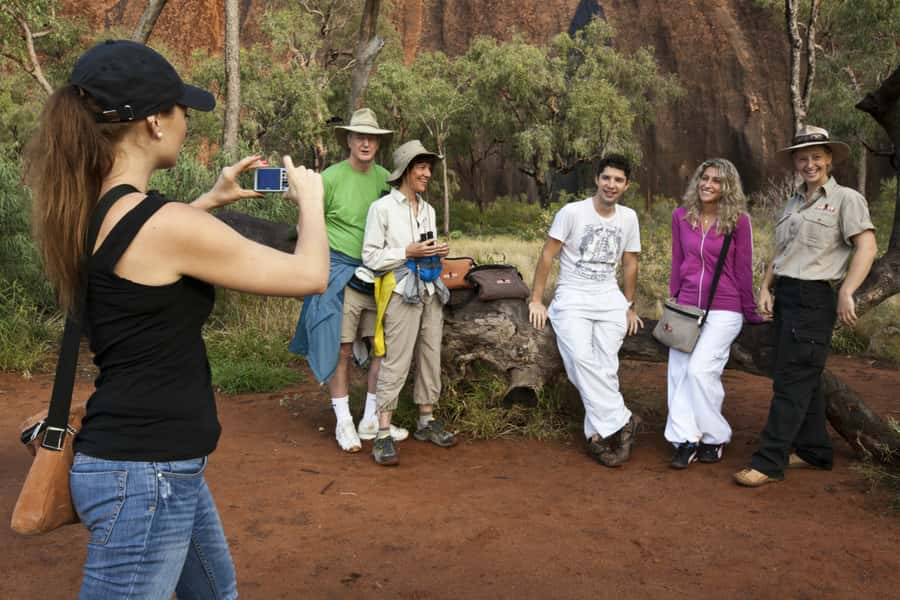
- Sunrise from Uluru’s base: Begin walking before dawn and watch the rock take on its first colours.
- A complete circuit: Cover the full base, including the Kuniya and Mala walking areas.
- Culture with context: Hear Anangu Tjukurpa creation stories linked to Liru, Kuniya, and the Mala people.
- Small vehicle and group: Travel in a comfortable vehicle with no more than 11 participants.
- Breakfast on the trail: Carry an outback picnic breakfast, with tea and coffee supplied.
- Languages beyond English: Optional audio guides are available in Spanish, Chinese, French, German, Italian, and Russian.
Why walking all the way around Uluru matters
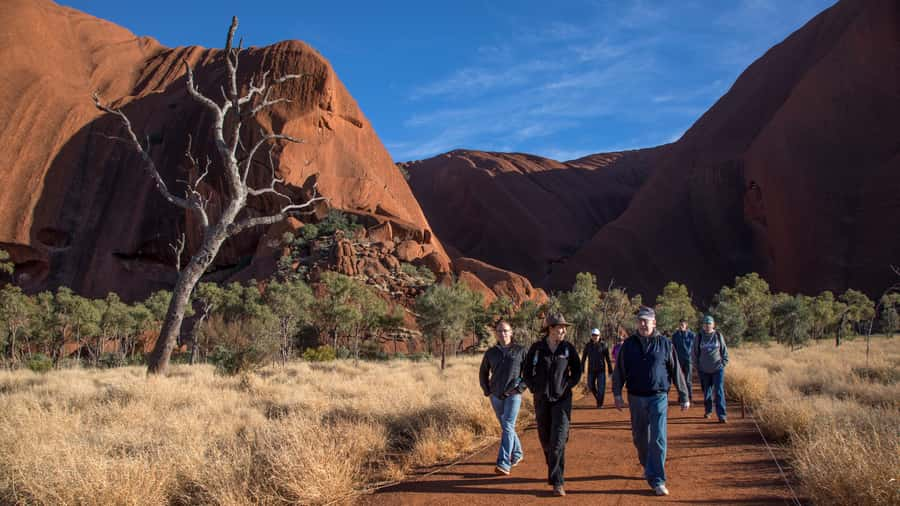
Uluru is easy to admire from a distance. The full base walk asks more of you, but it also gives you a far better sense of the place.
The rock changes constantly as you move. One section reveals sheer walls and caves. Another leads toward water. Markings, shadows, overhangs, and narrow folds in the stone give the monolith a different face every few minutes. A short stop at a viewing point cannot provide that same sense of scale.
The route is mainly flat, with gravel tracks that earlier walkers have described as easy underfoot. That does not make it a quick stroll. At roughly 10.5 kilometres, it is a proper half-day walk, especially when you stop for explanations, photos, water, and breakfast.
The walking pace is intended to be steady rather than rushed. Guides have allowed regular rests, and the small group format makes it easier to keep everyone together. One practical point: individual distance readings can vary. One participant recorded more than 14 kilometres, while the advertised distance is about 10.5 kilometres, so bring shoes and energy for a long morning.
More Small-Group Hikes in the world:
- Small Group Waterfall and Rainforest Hiking Adventure on Maui
★ 5.0 · 1,417 reviews - Glacier Hike and South Coast Small-Group Tour from Reykjavik
★ 5.0 · 827 reviews - Sólheimajökull Glacier Hike – Adventure in a Small Group
★ 5.0 · 799 reviews
Before sunrise, from Ayers Rock Resort to the trail
Pickup takes place from the front of your hotel reception within Ayers Rock Resort, about one hour before sunrise. If you are staying at Emu Walk Apartments, pickup is from Desert Gardens Hotel. At The Lost Camel, meet at Sails in the Desert.
The vehicle holds a maximum of 11 people. That number matters in the dark morning hours. You are not being moved in a large convoy, and the guide can speak to the group without a microphone or a long wait for stragglers.
The journey continues into Uluru Kata Tjuta National Park. As dawn approaches, Uluru comes into view as a dark, massive shape against the changing sky. You begin the walk before sunrise, positioning yourself for the first light rather than arriving after the best colours have passed.
Bring a warmer layer in the cooler months. Several people found the early morning chilly, even when the day later became hot. A hat, sunscreen, sensible walking shoes, and a water bottle belong in your kit year-round.
The national park entry ticket is not included in the $169 price. You can buy it at the entry station, and the ticket is valid for three consecutive days from the date of issue. If you plan to visit the park again during your stay, that three-day validity can make the extra cost more useful.
Sunrise sets the tone for the walk
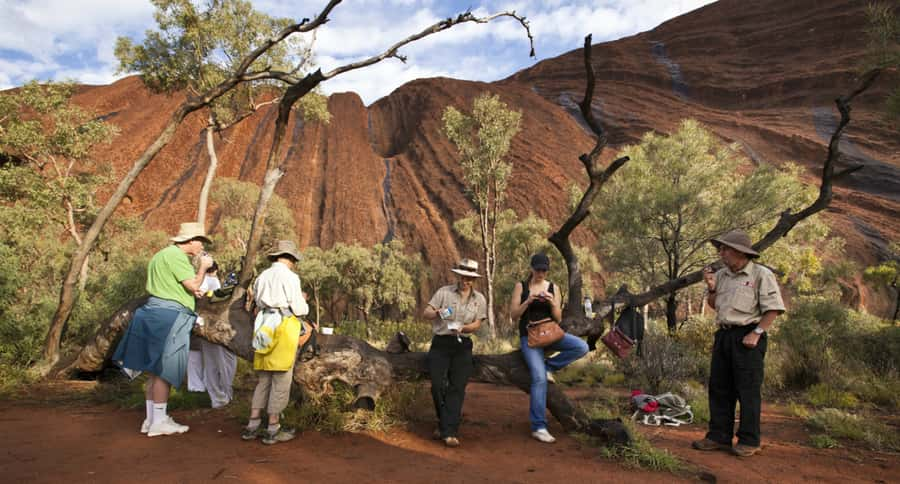
The sunrise is not a separate lookout stop tacked onto the itinerary. It forms the opening scene of the walk.
You see the first rays change Uluru from a dark bulk into a red and orange wall. The effect depends on the morning conditions, but the timing gives you a quiet start before the heat builds. One guide, Michael, has been praised for bringing water and chilled lemongrass towels for the warmer return section. That sort of care can make a real difference in the centre of Australia.
The early hour is also the main inconvenience. You need to be ready before most of the resort is properly awake. If you know you dislike early starts, this tour may feel long before the walking even begins. If you can manage the alarm, the cooler temperatures and soft light are strong reasons to do it this way.
Your guide remains with you throughout the walk, explaining the rock, the surrounding plants and animals, Anangu culture, and survival in this dry country. The best part is not simply learning a list of facts. It is understanding that Uluru is a living cultural place, not just a striking geological formation.
Kuniya Walk and Mutitjulu Waterhole
The Kuniya section leads to Mutitjulu Waterhole, one of the most important stops on the route.
Here, your guide explains the Tjukurpa story of Kuniya and Liru. These creation stories connect people, place, law, and the features of Uluru. Hearing the story beside the waterhole gives it a physical setting that a museum display cannot match.
Mutitjulu also shows why water is so important in this country. The waterhole is not simply a scenic pause. It helps explain how people and wildlife could live in such a dry region, and why particular places around Uluru carry great cultural weight.
You will want time here for photographs, but listen before reaching for the camera. Some parts of Uluru have strong cultural significance, and your guide can explain what is appropriate. The tour is at its best when the stories lead the visit, rather than becoming background noise for a photo stop.
More Guided Tours in the world:
- From Marrakech: Ouzoud Waterfalls Guided Hike and Boat Trip
★ 4.7 · 33,630 reviews - Bali: Sunrise Mount Batur Guided Hike with Breakfast
★ 4.8 · 9,660 reviews - Bali: Mount Batur Sunrise Guided Hike and Natural Hot Spring
★ 4.8 · 9,284 reviews - Mount Etna: Summit Guided Hiking Tour up to 3,400 m
★ 4.8 · 4,792 reviews
Rock art, caves, and the meaning of the walls
Ancient rock art sites are part of the base walk. Your guide points out markings and explains their place in the wider cultural story of Uluru.
The value of this stop lies in the detail. From a distance, the rock can look like one enormous surface. Close to the base, you see sheltered areas, caves, shaded recesses, and signs of long human use. The guide helps you read those features and understand why a particular hollow or wall matters.
Guides such as Lucia, Tim, Lily, Rachel, and Dimitri have been praised for bringing these cultural stories to life. Individual guide style will vary, but the tour is designed around live interpretation in English. If English is not your first language, an optional audio guide is available in Spanish, Chinese, French, German, Italian, and Russian.
That audio option is useful, but it will not replace the give-and-take of a live guide. If you want to ask about a detail in front of you, the English-led group is the main source of explanation. The audio guide is best treated as language support, not a separate tour.
Breakfast with tea and coffee on the trail
At some point during the circuit, you stop for an outback picnic breakfast. It comes in a carry pack, so you need to carry it until the break.
The breakfast is meant to be practical rather than lavish. Most people have found it sufficient for the walk, though one person wanted something more filling. If you normally need a large breakfast before exercise, consider eating something small at your hotel if your schedule allows, but do not expect a full cooked meal on the trail.
Tea and coffee are included. Water is your responsibility, so bring a bottle and take the heat seriously. There are water taps at two points along the route, but the water has been described as filtered rainwater with an earthy or metallic taste. Carry enough for your needs rather than relying entirely on those taps.
The picnic break also gives your legs a pause and lets you take in the quiet around the rock. You are still carrying your own supplies, so keep your pack sensible. A large load becomes tiring over several hours.
Mala Walk and Kantju Gorge
The Mala Walk leads toward Kantju Gorge, another major part of the circuit.
This section brings in the Tjukurpa story of the Mala people. The gorge shows a different side of Uluru, with tall rock walls and a more enclosed feeling than the open base sections. It is a good reminder that the rock is not visually repetitive. Every side has different folds, shadows, and formations.
Kantju Gorge is also one of the places where the guide’s interpretation makes the stop worthwhile. Without context, you might see a dramatic cleft in the rock and move on. With the story and cultural explanation, the place becomes part of a larger understanding of Anangu connection to Uluru.
The order of the circuit may affect your comfort in the sun. Some guides have walked counterclockwise so the second half of the route receives more shade as the day warms. That is a sensible approach, but conditions and exact timing can vary. Wear sun protection regardless.
What the small group adds
The maximum group size is 11, and the intimate scale is one of the tour’s strongest features.
A guide can check on people, answer questions, and adjust the pace more easily than on a large coach excursion. You also spend several hours with the same small set of people, which makes the walk feel more personal without turning it into a private tour.
The guide quality is central. Michael, Lily, Rachel, Max, Andy, Lucy, Georgia, Lara, Laura, Dimitri, and others have been singled out for their warmth, energy, care, and clear storytelling. Names alone cannot guarantee who will lead your departure, but the guiding approach is plainly a major part of the experience.
You also receive transport from your accommodation and a professional driver-guide. That removes the need to arrange your own early transfer into the national park. The transport received a 91 percent perfect score for its quality, and an air-conditioned vehicle is especially welcome once the day heats up.
Heat, fitness, and what to carry
Do not book this as a casual sightseeing transfer. Book it as a guided walk.
The path is mainly flat and generally easy to follow, but the distance is substantial. You need sensible walking shoes, sun protection, a hat, and clothing suited to changing temperatures. Cooler months can begin cold, while warmer months can become demanding by late morning.
Carry a water bottle and enough water for the full outing. One person carried four litres and drank it all, while other advice suggested carrying about two litres and refilling along the way. Your needs depend on the season, your pace, and your body, but underestimating the heat is the mistake to avoid.
A fly net for your face may be useful in warmer conditions. That is not supplied in the basic inclusions, and flies can make an otherwise pleasant stop irritating.
The guide should provide rest breaks, and the route has restroom access at two points. Still, you should be comfortable walking for several hours before booking. The tour has suited reasonably fit older walkers, but it may not suit anyone who struggles with long distances or early-morning exertion.
Is $169 good value?
At $169 per person, this is not the cheapest way to see Uluru. You are paying for more than transport to a viewpoint, though.
The price covers hotel pickup, air-conditioned transport, a professional driver-guide, a full base circuit, cultural interpretation, breakfast, tea, and coffee. It also buys a small group rather than a large bus setting. For a place as culturally important and physically imposing as Uluru, the guide’s explanations are a major part of what you are paying for.
The national park entry ticket costs extra, so include that in your total. The ticket lasts three consecutive days, which helps if you are also visiting other areas inside the park.
The value is strongest if you want one substantial Uluru morning and would otherwise need to arrange transport, entry, food, and your own interpretation. It is weaker if you only want a quick view of the rock or do not enjoy long walks.
Free cancellation is available up to three days in advance for a full refund. That gives you some flexibility, but the main decision is not the cancellation rule. It is whether a 10.5-kilometre walk before breakfast fits your plans and fitness.
Who should book this Uluru walk?
I would choose this tour if you want the full physical scale of Uluru and care about its cultural meaning. It suits people who prefer a guide to explain what they are seeing, rather than walking the trail without context.
It is also a good fit for solo visitors, couples, and families with older children who can handle the distance. The infant price includes touring and car seat hire, though the long walk still needs to suit your family.
I would think twice if you want a relaxed morning, dislike carrying water, or have limited walking ability. The trail may be flat, but flat does not mean short. The early pickup and heat add to the effort.
Should you book it?
Yes, if your priority is a complete and thoughtful look at Uluru rather than a quick photo stop. The sunrise start, small group, full base route, and stories connected to Kuniya, Liru, and the Mala people give the morning real substance.
Pack light but prepare seriously: walking shoes, water bottle, hat, sunscreen, warmer clothing for the early hours, and perhaps a fly net. Pay the separate park entry fee, accept that breakfast is modest, and allow your body time for the distance.
For most reasonably fit visitors, this is a strong way to meet Uluru on foot. The main question is not whether the rock is worth seeing. It is whether you are ready to meet it before dawn and keep walking.
FAQ
How long does the Uluru base walk tour last?
The tour lasts six hours, including hotel pickup, transport, the guided walk, breakfast, and the return journey to your Ayers Rock Resort accommodation.
How far do you walk around Uluru?
The walk is approximately 10.5 kilometres. Individual distance readings can vary, and one recorded walk was more than 14 kilometres, so prepare for a long morning on foot.
What time is hotel pickup?
Pickup is approximately one hour before sunrise. The exact starting time changes, so check availability for the date you want.
Where does pickup take place?
Pickup is from outside hotel reception within Ayers Rock Resort. Guests at Emu Walk Apartments meet at Desert Gardens Hotel, while guests at The Lost Camel meet at Sails in the Desert.
What languages are available?
The live guide speaks English. Optional audio guides are available in Spanish, Chinese, French, German, Italian, and Russian.
Is breakfast included?
Yes. An outback picnic breakfast is supplied in a carry pack, along with tea and coffee. The breakfast is designed for the trail and is not a full cooked meal.
Is the national park entry fee included?
No. The Uluru Kata Tjuta National Park entry ticket is purchased separately at the entry station. It is valid for three consecutive days from the date of issue.
What should I bring?
Bring sensible walking shoes, a water bottle, a hat, sunscreen, suitable walking clothes, and warmer clothing during cooler months.
How large is the group?
The group is limited to 11 participants, and transport is provided in a vehicle that accommodates a maximum of 11 people.
Recently reviewed hikes in the world
- Asheville: Yoga on a Mountain Hike★ 4.7 · 7 reviews
- Arequipa: 2-day Colca Canyon Trekking, Ending in Puno★ 4.8 · 8 reviews
- Arctic hike on Kvaløya Island with drinks and snacks★ 5.0 · 8 reviews
- Arctic Wilderness Hike from Rovaniemi (Day & Evening)★ 4.7 · 12 reviews
- Antelope Valley: Ligai Si Anii Canyon Hiking Tour★ 4.9 · 13 reviews
- Antigua: 2-Day Acatenango Volcano Hike w/Local Guide & Meals★ 4.3 · 43 reviews
- Delphi: Easy Hike on Ancient Path through the Olive Groves★ 5.0 · 9 reviews
- Antalya: Hiking in Termessos Ancient City★ 5.0 · 152 reviews
Australia Hiking Tours, compared.
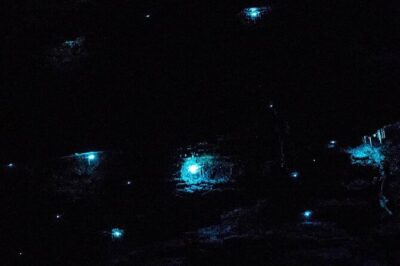
Blue Mountains Hiking Glow worms Cave Wildlife Spotlighting Night Adventure
Read our review →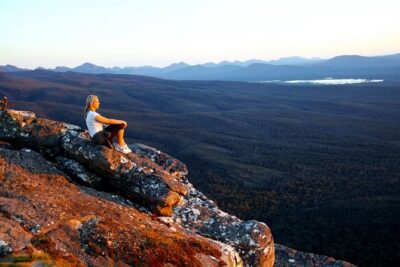
Small-Group Grampians Great Wildlife Escape Day Trip with Hiking
Read our review →